

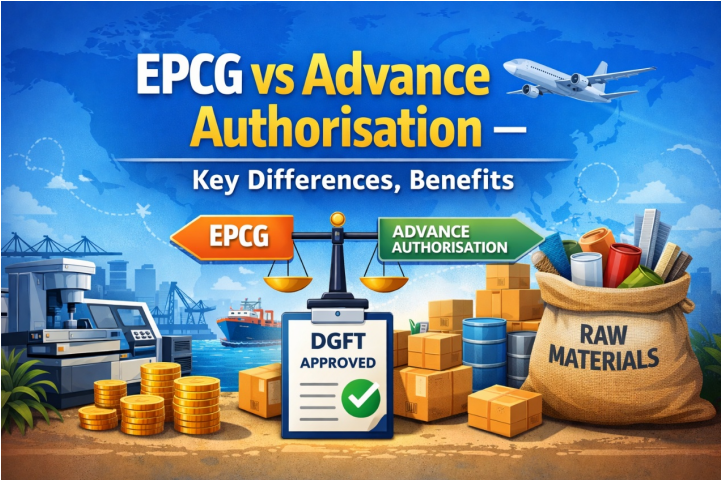

When it comes to reducing import costs and improving export profitability, businesses in India often rely on government schemes like EPCG (Export Promotion Capital Goods) and Advance Authorisation (AA).
While both schemes offer duty-saving benefits, they serve very different purposes and are designed for different business needs. Choosing the wrong scheme can lead to compliance issues, missed benefits, or financial inefficiencies.
In this guide, we’ll break down the difference between EPCG and Advance Authorisation, their benefits, eligibility, and help you decide which scheme is best for your business.
What is EPCG Scheme? (Export Promotion Capital Goods)
The EPCG scheme allows businesses to import capital goods such as machinery and equipment at zero or concessional customs duty, subject to an export obligation.
This scheme is ideal for businesses looking to expand production capacity or upgrade technology.
Key Features of EPCG
Duty-free import of capital goods
Applicable for machinery, equipment, and production tools
Requires fulfillment of export obligation
Supports long-term business growth
How EPCG Works
Under EPCG, a business can import machinery without paying import duty. In return, the company must export goods worth a multiple of the duty saved within a specified time period.
Save duty now, export more later
What is Advance Authorisation Scheme?
The Advance Authorisation (AA) scheme allows duty-free import of raw materials, components, or inputs required for manufacturing export products.
This scheme is focused on operational efficiency and production, rather than capital investment.
Key Features of Advance Authorisation
- Duty-free import of raw materials
- Input-output linkage (specific quantity usage)
- Export obligation based on finished goods
- Ideal for ongoing production
How Advance Authorisation Works
Businesses can import raw materials without paying duty, provided those materials are used to manufacture products that are exported.
EPCG vs Advance Authorisation – Key Differences
Understanding the difference between EPCG and Advance Authorisation is crucial for choosing the right scheme.
| Factor | EPCG | Advance Authorisation |
| Purpose | Import capital goods | Import raw materials |
| Usage | Machinery & equipment | Inputs for production |
| Investment Type | Long-term | Short-term/operational |
| Export Obligation | Based on duty saved | Based on input-output norms |
| Business Focus | Capacity expansion | Production efficiency |
Simple takeaway:
EPCG = Machinery investment
Advance Authorisation = Raw material import
Which Scheme is Better for You? (Decision Guide)
Choosing between EPCG and Advance Authorisation depends on your business model and requirements.
✅ Choose EPCG if:
You are importing machinery or equipment
You want to expand or upgrade production
You are making long-term investments
✅ Choose Advance Authorisation if:
You import raw materials regularly
You manufacture goods for export
You want to reduce production costs
Some businesses may benefit from both schemes:
Use EPCG for machinery
Use Advance Authorisation for raw materials
Benefits Comparison – EPCG vs Advance Authorisation
Both schemes reduce import costs, but the nature of benefits differs.
- Saves duty on capital goods
- Improves production capacity
- Supports long-term growth
- Eliminates duty on raw materials
- Reduces production cost
- Improves cash flow
- EPCG = Investment-focused
- AA = Production-focused
Eligibility & Export Obligation Comparison
Both schemes involve export obligations, but their structure differs significantly. Under EPCG, businesses import capital goods and commit to exporting goods worth a multiple of the duty saved, making it a value-based obligation. In contrast, Advance Authorisation allows the import of inputs for export production, where exporters must follow standard input-output norms, resulting in a quantity or product-based obligation.
How These Schemes Help Reduce Import Costs
Import duties can significantly increase business costs, especially for manufacturers. Both EPCG and Advance Authorisation help address this by eliminating or reducing customs duty, lowering overall production costs, and improving profit margins. As a result, businesses can offer better pricing in global markets, enhance their competitiveness, and increase export opportunities.
Common Mistakes Importers Make
Many businesses fail to maximize benefits due to:
❌ Choosing the Wrong Scheme
Not aligning scheme with business needs
❌ Misunderstanding Export Obligation
Leads to penalties
❌ Poor Documentation
Causes delays or rejection
❌ Compliance Issues
Non-fulfillment of obligations
Can You Use Both EPCG and Advance Authorisation?
Yes, businesses can use both schemes, but for different purposes.
EPCG → For capital goods
AA → For raw materials
How AFLEO Helps You Choose the Right Scheme
Choosing between EPCG and Advance Authorisation can be complex, as it involves understanding business requirements, compliance rules, and export obligations. At AFLEO, we simplify this process by providing expert guidance on selecting the right scheme, complete documentation support, DGFT compliance assistance, export obligation management, and end-to-end EXIM consultancy, ensuring a seamless and efficient experience for your business.
FAQs
What is the main difference between EPCG and Advance Authorisation?
EPCG is for importing capital goods, while Advance Authorisation is for importing raw materials.
Which scheme is better for manufacturers?
Manufacturers often use both—EPCG for machinery and AA for raw materials.
Can both schemes be used together?
Yes, but for different purposes and with proper compliance.
What is export obligation in EPCG?
It is the requirement to export goods worth a multiple of duty saved.
How are benefits calculated?
Benefits depend on duty saved and export value or input usage.
Conclusion
Both EPCG and Advance Authorisation are powerful schemes designed to reduce import costs and support exporters in India. However, choosing the right scheme depends on your business model, whether you are investing in machinery or importing raw materials for production.
EPCG = Capital goods (long-term investment)
Advance Authorisation = Raw materials (production use)
Understanding the difference between EPCG and Advance Authorisation helps you:
Reduce import costs
Improve profitability
Stay compliant with regulations
Need Help Choosing the Right Scheme?
If you’re unsure which scheme suits your business, expert guidance can make a significant difference. AFLEO offers complete support for EPCG and Advance Authorisation schemes, along with DGFT compliance and comprehensive import-export consultancy, ensuring that your business chooses the right approach and maximizes available benefits.