

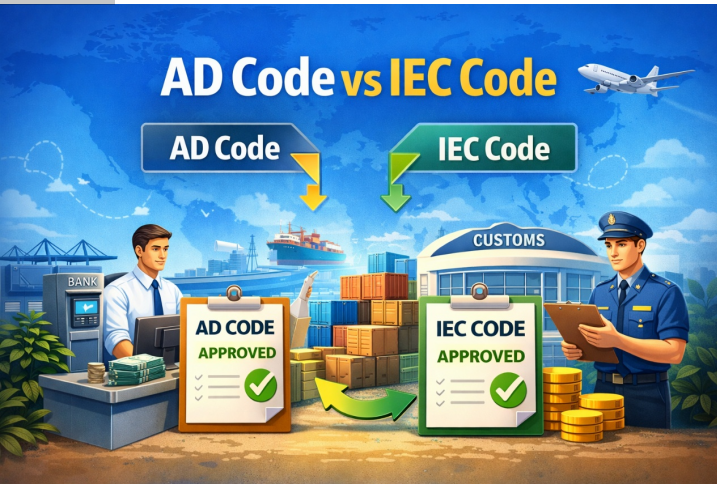

Starting an import-export business in India involves multiple registrations and compliance requirements. Among the most important are the IEC Code (Import Export Code) and the AD Code (Authorized Dealer Code).
Many exporters and importers often get confused between these two, wondering whether they need both, what each one does, and how they fit into the export process.
If you’re planning to start exporting or already facing issues in documentation, this guide will help you clearly understand the difference between AD Code and IEC Code, their roles, and why both are essential.
What is IEC Code? (Import Export Code Explained)
The IEC Code (Import Export Code) is a unique 10-digit identification number issued by the Directorate General of Foreign Trade (DGFT).
It is the first and most essential requirement for any business that wants to import or export goods from India.
Key Features of IEC Code
The IEC Code is mandatory for all import and export activities and is issued by the Directorate General of Foreign Trade (DGFT). It is valid for a lifetime, meaning no renewal is required once obtained. Additionally, the IEC Code is essential for customs clearance and is used in all international trade transactions, making it a crucial requirement for businesses involved in global trade.
Why IEC Code is Important
Without an IEC Code, a business cannot export or import goods, as it is a mandatory requirement for international trade. Additionally, exporters without an IEC Code are not eligible to avail benefits under government export schemes, making it an essential registration for anyone looking to operate in global markets.
What is AD Code? (Authorized Dealer Code Explained)
The AD Code (Authorized Dealer Code) is a 7-digit code issued by your bank (authorized dealer bank) where your export payments are received.
It is used by customs authorities to track foreign currency transactions related to exports.
Key Features of AD Code
- Issued by your bank
- Linked to your current account
- Mandatory for export shipments
- Required at port level
Why AD Code is Important
Without AD Code:
- You cannot generate a shipping bill
- Export shipments may get stuck at customs
- Payments cannot be properly tracked
AD Code links your export transactions to your bank account
AD Code vs IEC Code – Key Differences
Understanding the difference between AD Code and IEC Code is crucial for smooth export operations.
| Factor | IEC Code | AD Code |
| Issued By | DGFT | Bank |
| Purpose | Business identification | Payment tracking |
| Mandatory | Yes | Yes (for export) |
| Usage | Import & export | Export (customs) |
| Linked To | Business entity | Bank account |
| Validity | Lifetime | Depends on bank |
Why Both AD Code and IEC Code Are Required
Many beginners assume that having an IEC Code is enough to start exporting. However, that’s not the case.
Legally import/export
Register with DGFT
Access export benefits
Process shipping bills
Link exports with your bank
Receive foreign payments
IEC Code = Your license to trade globally
AD Code = Your financial connection for exports
Both are essential and work together in the export process.
Role of IEC Code in Import Export Process
The IEC Code plays a central role in international trade, as it is used across various stages of the export-import process, including customs clearance, shipping documentation, and DGFT registrations. It is also essential for availing export incentives and benefits. Most importantly, the IEC Code identifies your business globally, enables legal import and export activities, and serves as the foundation for all export-related registrations.
Role of AD Code in Export Process & Customs Clearance
The AD Code is specifically important during the export process, especially at the customs level, as it is required for shipping bill filing, ICEGATE registration, and customs clearance. It plays a crucial role in export payment tracking by linking export transactions to the exporter’s bank account. Additionally, it helps customs authorities verify the flow of payments and ensures compliance with RBI guidelines.
End-to-End Export Process (IEC + AD Code + ICEGATE)
To understand how both codes work together, here’s a simplified export process:
- Apply for IEC Code from DGFT
- Open a current account in a bank
- Get AD Code from the bank
- Register AD Code on ICEGATE portal
- File shipping bill with AD Code
- Export goods
- Receive payment in bank
Common Mistakes Exporters Make
Many exporters face delays or losses due to avoidable mistakes:
❌ Not Registering AD Code on ICEGATE
Without this, shipping bills cannot be processed
❌ Incorrect IEC Details
Leads to documentation errors
❌ Not Linking AD Code with Port
Each port requires proper AD Code registration
❌ Lack of Awareness
Not understanding roles of each code
- Shipment delays
- Payment issues
- Loss of export benefits
Documents Required for AD Code & IEC Registration
- PAN card
- Business registration proof
- Address proof
- Bank details
- Bank certificate
- IEC Code copy
- GST certificate
- Authorization letter
AD Code vs IEC Code for Different Business Types
Businesses involved in exports, including manufacturers and traders, require both an IEC Code and an AD Code, as they are essential for smooth export operations. MSMEs must register for an IEC Code to start exporting, while the AD Code is necessary for processing shipments and handling export payments. In all cases, the IEC Code is mandatory for international trade, and the AD Code is required to ensure proper payment processing and customs compliance.
Can You Export Without AD Code or IEC Code?
❌ Without IEC Code:
You cannot export at all
❌ Without AD Code:
Your shipment will not be processed
You need both to run a successful export business
How AFLEO Helps with AD Code & IEC Registration
Managing export registrations and compliance can be confusing, especially for new businesses. At AFLEO, we simplify the entire process by offering complete support, including IEC Code registration, AD Code registration with banks, ICEGATE registration assistance, export documentation guidance, and end-to-end EXIM consultancy, ensuring a seamless and hassle-free export experience.
FAQs
What is the main difference between AD Code and IEC Code?
IEC Code is a business identification number, while AD Code is used for tracking export payments through banks.
Is AD Code mandatory for export?
Yes, AD Code is required for shipping bill processing and customs clearance.
Can I export without IEC Code?
No, IEC Code is mandatory for any import-export activity in India.
Do I need separate AD Code for each port?
Yes, AD Code must be registered at each port where exports are made.
How long does IEC registration take?
IEC registration is usually completed within a few days if documents are correct.
Conclusion
Both AD Code and IEC Code are essential components of the export process in India. While IEC Code acts as your identity in international trade, AD Code ensures that your financial transactions are properly tracked and processed.
IEC Code = Business identity
AD Code = Banking & payment link
Understanding their roles can help you avoid errors, streamline your export operations, and ensure compliance with regulations.